

Introduction
Cowboy is a Layer 1 blockchain designed from the ground up for autonomous agents and verifiable off-chain computation. This document provides a high-level overview of the system architecture.
TL;DR: Cowboy combines a Python-based Actor VM, dual-metered gas system, native timers, and verifiable off-chain compute into a cohesive protocol for next-generation decentralized applications.
Note: Examples and names shown in this page (including diagrams) are conceptual and illustrative. Final interfaces and usage should follow the SDK and Developer Guide; CIP specifications define normative protocol behaviors.
System Architecture
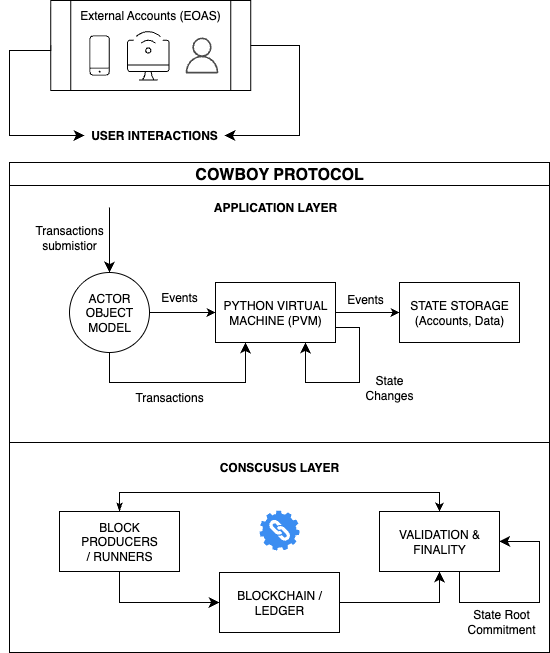
Core Components
1. Actor VM (Python Runtime)
Purpose: Execute actor (smart contract) code deterministically
Key Features:
- Python bytecode interpreter (no JIT)
- Deterministic execution (no system calls, software FPU)
- Dual-metered gas (Cycles for compute, Cells for data)
- Sandboxed environment (no I/O, no network)
Architecture:
+------------------------------------------------------------+
| Actor VM |
| |
| +------------------------------------------------------+ |
| | Python Bytecode Interpreter | |
| | - Instruction dispatch | |
| | - Stack management | |
| | - Cycle metering | |
| +------------------------------------------------------+ |
| |
| +------------------------------------------------------+ |
| | Host Functions | |
| | - storage.get / storage.set | |
| | - send_message() | |
| | - set_timeout() | |
| | - submit_task() | |
| +------------------------------------------------------+ |
| |
| +------------------------------------------------------+ |
| | Determinism Layer | |
| | - Software floating-point | |
| | - Module whitelist | |
| | - No JIT compilation | |
| +------------------------------------------------------+ |
+------------------------------------------------------------+
Note: Host function names shown in the diagram (e.g., storage.get/set, send_message, set_timeout, submit_task) are conceptual placeholders. Refer to the SDK and Developer Guide for the authoritative API surface.
See: Actor VM Overview
2. Consensus Layer (HotStuff BFT)
Purpose: Achieve agreement on block ordering and finality
Key Features:
- Byzantine Fault Tolerant (BFT)
- Deterministic finality (no reorgs)
- Leader-based block proposal
- Quorum certificates (QC) for votes
Flow:
Block Proposal Flow:
1. Leader proposes block
2. Validators validate:
|-- Transactions valid?
|-- State transition correct?
\-- Gas limits respected?
3. Validators vote (signature)
4. QC formed (2/3+ votes)
5. Block finalized
6. Next leader elected
Properties:
- Safety: No forks (deterministic finality)
- Liveness: Progress guaranteed with 2/3+ honest validators
3. Dual-Metered Gas System
Purpose: Fair resource pricing for compute and data
Architecture:
Transaction Execution
|
|-- Compute Operations
| |-- Bytecode execution -> Charged in Cycles
| |-- Function calls -> Charged in Cycles
| \-- Hash computations -> Charged in Cycles
|
\-- Data Operations
|-- Transaction payload -> Charged in Cells
|-- Storage writes -> Charged in Cells
\-- Return data -> Charged in Cells
Independent Fee Markets:
- Each resource has its own basefee
- Basefees adjust independently (dual EIP-1559)
- Prevents cross-subsidization
See: Fee Model
4. Timer Scheduler (CIP-1)
Purpose: Native timer scheduling with autonomous execution
Architecture:
+------------------------------------------------------------+
| Hierarchical Calendar Queue |
| |
| +------------------------------------------------------+ |
| | Layer 1: Block Ring Buffer | |
| | [B+0][B+1][B+2]...[B+255] | |
| | O(1) access for near-term timers | |
| +------------------------------------------------------+ |
| |
| +------------------------------------------------------+ |
| | Layer 2: Epoch Queue | |
| | [E+1][E+2]...[E+N] | |
| | Buckets for mid-term timers | |
| +------------------------------------------------------+ |
| |
| +------------------------------------------------------+ |
| | Layer 3: Overflow Sorted Set | |
| | Merkle BST for long-term timers | |
| +------------------------------------------------------+ |
+------------------------------------------------------------+
|
v
+------------------------------------------------------------+
| Gas Bidding Agents (GBA) |
| - Each actor specifies GBA contract |
| - GBA returns bid based on block context |
| - Priority queue orders by effective bid |
+------------------------------------------------------------+
Execution Flow:
- Actor schedules a timer (conceptual API; CIP-1 requires specifying a Gas Bidding Agent)
- Timer stored in calendar queue
- At trigger block:
- Query GBA for bid
- Add to priority queue
- Execute highest bids first (within budget)
See: Scheduler Overview
5. Off-Chain Compute (CIP-2)
Purpose: Verifiable execution of AI models, API calls, heavy computation
Architecture:
+------------------------------------------------------------+
| On-Chain Components |
| |
| +--------------------+ +--------------------+ |
| | Task Dispatcher | | Runner Registry | |
| | - Submit task | | - Registration | |
| | - Lock payment | | - Active list | |
| | - VRF snapshot | | - Health decay | |
| +--------------------+ +--------------------+ |
| |
| +--------------------+ |
| | Runner Submit | |
| | - Verify select | |
| | - Store result | |
| | - Trigger CB | |
| +--------------------+ |
+------------------------------------------------------------+
| Task & Result submission |
v
+------------------------------------------------------------+
| Off-Chain Runners |
| |
| +------------------------------------------------------+ |
| | Runner Service | |
| | - Monitor TaskSubmitted events | |
| | - Calculate VRF selection | |
| | - Execute: download model, run inference | |
| | - Generate proof (if required) | |
| | - Submit result on-chain | |
| +------------------------------------------------------+ |
+------------------------------------------------------------+
Selection Mechanism (VRF-based):
// Pseudocode (conceptual): VRF Selection = Deterministic + Verifiable + Decentralized
start_index = hash(vrf_seed + (submission_block - vrf_generation_block)) % active_list_size
selected_runners = active_list[start_index : start_index + N] # wrap around (ring buffer)
✅ No central coordinator
✅ Anyone can verify selection
✅ Fair over time
See: Off-Chain Compute
Transaction Lifecycle
1. Transaction Submission
|-- User creates transaction
|-- Signs with private key
\-- Broadcasts to network
2. Mempool
|-- Validators receive transaction
|-- Validate signature, nonce, balance
\-- Add to mempool (priority by tip)
3. Block Proposal
|-- Leader selects transactions from mempool
|-- Orders by priority (effective tip)
\-- Proposes block
4. Block Validation
|-- Validators execute transactions
|-- Check state transitions
|-- Verify gas limits
\-- Sign vote (QC)
5. Block Finalization
|-- QC formed (>= 2/3 votes)
|-- Block committed to chain
|-- State root updated
\-- Receipts generated
6. State Update
|-- Actor state persisted
|-- Balances updated
|-- Events emitted
\-- Next nonce incremented
State Organization
Global State (σ)
|-- Accounts
| |-- Balances (address -> amount)
| |-- Nonces (address -> uint64)
| \-- Actor Code (address -> bytecode)
|
|-- Actor State
| \-- Key-Value Storage (actor_address + key -> value)
|
|-- Scheduler State
| |-- Timer queues (hierarchical calendar queue)
| \-- Scheduling indices and metadata
|
|-- Off-Chain State
| |-- Active Runner List
| |-- Pending Tasks
| \-- Task Results
|
\-- Protocol State
|-- Validator Set
|-- Basefees (cycle & cell)
\-- Governance Parameters
State Root: Merkle tree root of entire state
State Transition: σ' = STF(σ, B) where B is block
Network Layer
P2P Network:
- Gossip protocol for transaction propagation
- Block proposal distribution
- Vote (QC) aggregation
- State synchronization
Node Types:
- Validator: Participates in consensus, proposes/validates blocks
- Full Node: Stores full state, serves queries
- Light Client: Only block headers, verifies proofs
- Runner: Executes off-chain tasks (not part of consensus)
Communication:
Validators <--> P2P Network <--> Full Nodes
↕
Runners (off-chain)
• Monitor events
• Submit results
Storage Layer
Components:
-
State Storage:
- Merkleized key-value store
- Key: account/actor address + storage key
- Value: serialized data
- Root hash in block header
-
Block Storage:
- Sequential blocks
- Headers + transactions
- Indexed by height and hash
-
Transaction Log:
- All transactions (historical)
- Receipts with events
- Queryable by hash, block, address
-
Archive Node (optional):
- Full historical state
- Every block’s complete state
- For queries like “balance at block X”
Security Model
Threat Model:
- Byzantine validators (up to 1/3)
- Malicious actors (smart contracts)
- DoS attacks (computational, storage)
- Network attacks (eclipse, Sybil)
Defenses:
-
Consensus Security:
- BFT tolerance (2/3+ honest required)
-
VM Security:
- Sandboxed execution (no I/O)
- Resource limits (cycles, cells, memory)
- Deterministic execution (no non-determinism)
-
Gas Economics:
- Dual-metered prevents abuse
- Basefee burn (anti-spam)
- Priority market (fair access)
-
Off-Chain Security:
- VRF-based selection (no coordinator)
- Configurable verification requirements (per CIP-2)
- Economic incentives (per application design)
Performance metrics, governance processes, and network parameters are implementation-dependent and subject to change. Refer to authoritative releases and CIPs for normative updates when available.
Next Steps
Further Reading